The ongoing Iran crisis and the effective closure of the Strait of Hormuz are putting some difficult scenarios on the table, mainly related to Saudi Arabia's position as OPEC’s largest exporter.
In recent decades, global oil markets have relied on a comforting assumption that may no longer be true. Until now, even during the closure of Hormuz and attacks on Arab oil and gas infrastructure, markets believe that Saudi Arabia, as stated before, will always be able to fill in any gaps in the system, even when there is severe stress. Most analysts continue to focus on the Kingdom's expected vast spare production capacity, which is slated to be between 2 and 3 million barrels per day.
This option in the market, fully used by Riyadh to project power and stability, has so far served as the ultimate stabilizing force. Global leaders, military strategists, but especially traders and energy ministers, from Washington to Brussels or Beijing to India, all still assume that if geopolitical disruptions hit global supply, Riyadh will be able to open the taps and deliver the barrels. None of these parties, even when some analysts warned about the possibility of closing Hormuz, has even blinked an eye until now.
The current unfolding maritime crisis around the Persian Gulf and the Strait of Hormuz is, and will be for years, exposing the inherent and structural weakness in that assumption. Spare production capacity, in any case but especially in times of major crises, matters only if the oil can actually leave the country and be delivered; the last two issues are mostly overlooked or refused to be addressed. In recent days, the Kingdom’s ability to export its crude, not yet its production, has become the real constraint.
The sudden collapse in tanker traffic through the Strait of Hormuz, not due to a military closure but effectively by threats and emotions, resulting in insurance removal, has turned the global oil system’s most critical chokepoint into a logistical bottleneck not seen before. As is widely known, in a normal situation, around 20 and 21 million barrels per day of oil and petroleum products, respectively, pass through Hormuz. This total currently represents around 20% of global oil consumption. Of these volumes, Saudi Arabia exports around 6 to 6.5 million bpd of crude through the strait on any given day.
Most of these barrels are heading to Asian markets, mainly China.
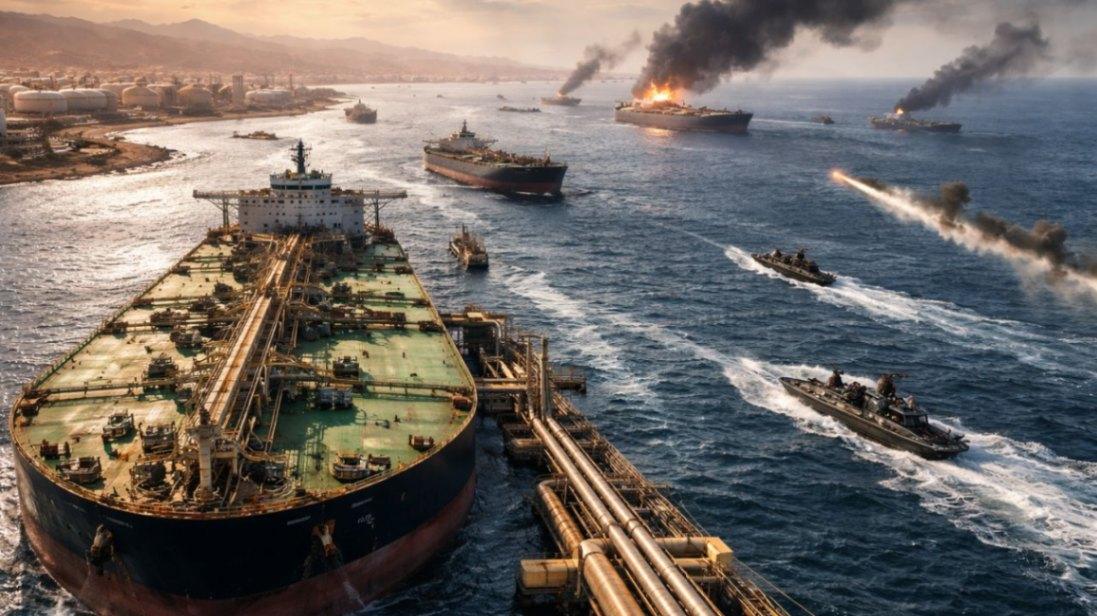
At present, Hormuz and the Arabian/Persian Gulf, due to the current escalation between Iran, the United States, and Israel, have become a high-risk war zone, with the result that maritime traffic has collapsed. Vessel transits, which normally average more than 130 ships per day, are now reported to be less than a handful, as insurers reassess risk exposure and naval deployments intensify across the Gulf. Even after US President Trump’s statements, traffic has not reacted at all.
Congestion has been the main result, as hundreds of vessels, ranging from very large crude carriers to LNG tankers, have anchored or are drifting across the Persian Gulf and the Gulf of Oman. Some shipping companies have indicated that they are waiting for security guarantees, while others have indicated that they are waiting for insurance coverage. Both options seem, at present, not at all available, as naval escorts are out of range (due to engagements with Iran), and insurance is very hesitant. Most vessels are simply waiting for clarity.
For Saudi Arabia, the total conundrum presents it with paralysis that is much more than a normal maritime disruption. It strikes directly at the heart of its export system, but ultimately even at its global power position.
Normally, Saudi Arabia exports around 7 million bpd of crude oil, making it the single largest exporter in the global market. Most of these volumes originate from terminals on the Persian Gulf, such as Ras Tanura and Juaymah. The closure of Hormuz has made it impassable, or, realistically, commercially uninsurable. Riyadh and Dhahran (Aramco HQ) will now be forced to find another route to market for these barrels, as the world is expecting and needing them.
An alternative route exists. Optimism should, however, be tempered, as it could be much narrower than markets often assume.
In recent days, reports have focused on Saudi Arabia’s principal bypass to Hormuz, the East-West crude oil pipeline, also known as Petroline. The pipeline stretches over 1200km from Abqaiq in the Eastern Province (Saudi Arabia’s main oil region) to the Red Sea port of Yanbu. The Kingdom set up the pipeline during the Iraq-Iran War (1980s) to mitigate exposure to Hormuz and to provide a strategic escape route for Saudi oil exports.
In principle, the existing infrastructure appears formidable, as it is perceived to have a capacity of 5 million bpd. Some Saudi assessments are even claiming around 7 million bpd due to upgrades. Based on these figures and given that the market has assumed they are set in stone, Saudi Arabia could redirect most of its Gulf exports toward the Red Sea if Hormuz were compromised.
Again, the situation seems to be more complicated.
Where most analyses fail is that they need to understand that pipeline capacity is only one part of the equation. At present, the main bottleneck is the Red Sea export terminals. Even though all terminals can handle significant volumes, such as Yanbu’s loading infrastructure, which is spread across several terminals, including the King Fahd Industrial Port and the Yanbu South facility, there are strong indications that this does not necessarily mean the entire flow that Saudi Arabia normally ships through the Gulf.
Existing industry assessments have stated that the combined export capacity of Yanbu’s crude terminals is likely to be between 4 and 5 million bpd. These volumes are only being reached under optimal operating conditions. The latter assumes the availability of high levels of operational efficiency and, maybe even more pivotal, sufficient tanker availability.
In other words, even if the pipeline were able to transport seven million bpd of crude physically, the available terminals on the Red Sea may not be able to load these volumes onto ships (if available) quickly enough. The gap between theoretical pipeline capacity and practical export capability has always mattered, but now it comes suddenly into plain sight.
The first signs of this constraint have popped up in shipping data. Over the past several days, as expected, the Saudi NOC has diverted crude shipments westward, dramatically increasing loading activity at Yanbu. Available data already show, especially based on tanker tracking, that Saudi Red Sea crude exports have increased to roughly 2.5 million bpd, a steep increase compared to the normal situation of less than one million bpd. This increase shows that the system, in principle, works, but also reveals its limits.